What if your customer does not ever go to your website, but decides to go with your business or brand based on the video they watched? No, it's not my exaggeration; it is already happening.
We all know that we are addicted to our smartphones for almost everything. Now, we try to find the best solution in an engaging way. Videos are considered the main way for people to seek any information, to make buying decisions, to learn, and more. Users mainly trust videos more than any other form of content. Whether it is for product reviews or service comparisons, users prefer video for better visual clarity, stronger context, and greater trust.
Strong data also backs this shift. According to recent industry research, video content is expected to account for over 82% of all internet traffic by 2026, showing how dominant video has become in online discovery and marketing.’
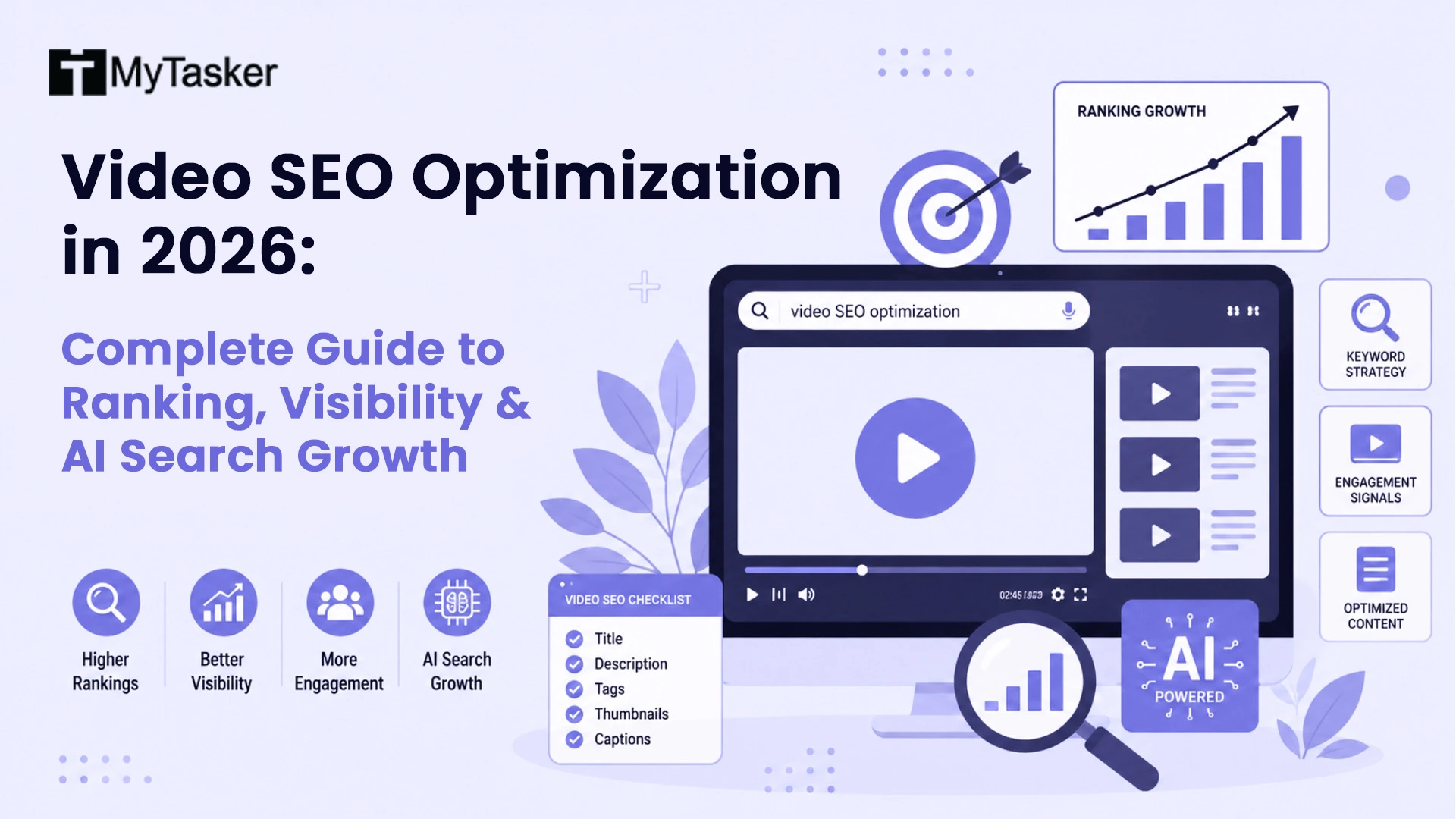
Video SEO Optimization is the process of improving video visibility across search engines, video platforms, and AI-driven discovery systems.
For businesses, this shift has made video SEO optimization a critical part of any digital growth. This is no longer considered an optional tactic. At MyTasker, we help your business grow with Video SEO Optimization through our skilled team. Our goal is to enhance rankings, visibility, and engagement across different platforms such as YouTube and Google to drive organic reach and engagement.
With this innovative approach, it is important to adapt to new ranking systems. Video SEO optimization aims to focus on engagement, relevance, and content understanding. This blog will take you to the depths of Video SEO optimization in 2026, including tips and tricks and more.
What is Video SEO Optimization?
Video SEO optimization is not rocket science; it's just a strategy to build success.
It's a comprehensive and effective process that aids in discovering, ranking and recommending videos on various platforms. It's more than just applying the keyword.
In simple terms, video SEO ensures that your content is able to reach the right audience at the right time. Besides, it assists the search engines comprehend the algorithm of your video, such as 'what the video is actually about and why it ought to be presented to the target viewers'. It mostly relies on the subject, situation, and additional information.
Previously, video SEO optimization meant keywords, tags and metadata. In 2026, however, optimization becomes more organic – not just considering the content of the video from the title or description, but also what happens within the video itself.
Modern systems interpret:
-
Spoken language through transcripts
-
Visual context through frame analysis
-
Audience engagement signals like retention and watch time
-
Behavioral signals such as replays, shares, and comments
In essence, Video SEO has shifted from “keyword matching” to “intent and meaning matching.” Search engines are no longer just indexing pages; they are interpreting content.
How Video Ranking Systems Work in 2026?
We know that video ranking in 2026 has evolved and depends on a hybrid system. This is an intelligent integration of engagement signals, metadata relevance, and AI-powered content comprehension. In order to grasp innovative optimization, it's essential to comprehend how ranking works today.
Traditional signals still matter.
It's not as if search engines like Google and all the rest have lost their fundamental story, with modern style. These search engines continue to use the original signals like thumbnails, tags, description and title. These are key factors to classify content and make some preliminary decisions about visibility.
Engagement is now a primary ranking factor
Engagement level is now one of the best ranking factors. Moving towards behavioural data. Videos are favored by platforms to engage users because they have:
-
When sufficient watch time is present, such as the length of time people remain
-
Wherever possible, the percentage of people who left the show.
-
Click-through rate, or we can say CTR.
-
Interaction signals such as likes, comments, and shares.
The algorithms are based on the method of analyzing the audience's behavior after watching your video, and then it calculates watch time, likes, comments, shares and more. The following are the necessary engagement signals to show whether or not your videos meet user intent or not. This directly impacts visibility and recommendations.
AI understanding layer
An AI comprehension layer has been put into modern ranking systems. This includes automatic transcriptions, scene recognition, and semantic topic mapping. These systems enable platforms to interpret the actual content of a video, rather than the metadata, and hence make it much more accurately searchable and recommendable.
‘Video ranking in 2026 follows a simple formula: relevance + engagement + machine understanding.’
Core Pillars of Video SEO Optimization
You could say video SEO has come a long way. These days, if you want to rank a video, it is not just a matter of throwing in the right keywords. The search engines and video platforms have changed their tune; they are far more concerned with whether your video is useful, relevant or entertaining. To put some numbers on your video performance, there are four main areas you should be looking at.
1. Intent-Driven Keyword Strategy
Start by understanding how people go about finding a topic. Don’t simply chase after popular keywords; think about what the user is querying and the answers they are after. You have to know what the viewer expects to get out of your video before you even make it. Are they in the market to buy something? Do they want to pick up a new skill or just find out something? If your video is there to serve that need, you will have better luck turning up in the results.
Key Points
-
To grasp users' information needs
-
Identify topics suitable for a video presentation
-
Review competing videos
-
Develop content that addresses real issues
2. Content Quality and Retention
It's important to produce quality content, but it's also crucial to hold their attention.
Most viewers make their decision to go on to watch within a few seconds. They can maintain their interest in your video if you have a strong introduction, clear explanations and a logical order.
Key Points
-
Capture attention early
-
Keep the content organized
-
Provide useful information
-
Keep the flow from one part to another smooth;
Videos that maintain viewers' attention tend to outperform in search and recommendations.
3. Metadata Optimization
Meta data provides information about the video for the platform to understand what it is.
This includes the title, description, tags, and the transcript. The purpose is to keep it clear and on point without overstuffing the page with keywords.
Key Points
-
Write clear titles
-
Use informative descriptions
-
Add relevant tags
-
Ensure metadata matches the video content
Optimizing your video metadata helps search engines better tag and show the video.
4. Engagement Design
Engagement is the message to your audience that you want them to relate to.
The number of comments, shares, likes, and extended viewing times indicates that the video is useful to people. Video structure can be changed with little effort and can lead to increased viewing time and increased content exploration.
Key Points
-
Ask questions to encourage comments
-
Encourage viewers to express their views
-
Define playlists/Content series
-
Suggest another video to view
The more people engage with the video, the more likely it is to be seen and the more people it can reach.
Tips and Tricks for Video SEO Optimization in 2026
In 2026, video is more dominant than ever in its role as the primary channel for digital content. It is becoming increasingly difficult to distinguish oneself in the marketplace as billions of videos are uploaded and viewed daily, not only on YouTube, but across social media and business websites.
The preference of search engines for video content is primarily due to its ability to maintain higher levels of audience engagement, enrich the audience experience, and provide information in a more easily digestible format.
This guide seeks to identify the best ways to successfully implement video SEO in 2026.
1. Understand the Behavioral Intent behind the Search
The search engines of today are capable of much more than a simple keyword match. Understand the outcome that the audience is looking to achieve before you create a video.
Things to consider:
-
Are they looking for information?
-
Do they want to see a how-to?
-
Are they trying to make a purchase comparison?
-
Are they looking for a distraction?
The more clearly you answer the questions that your audience is asking, the more views and engagement you will receive, and the more you will improve your ranking. To answer the question comprehensively, utilize keyword tools and surveys, forums and other engagement metrics.
As an example, instead of creating a random fitness video, create a video that is more targeted, for example, “10-Minute Home Workout for Beginners” or “Best Weight Loss Exercises for Busy Professionals”
2. Use Better Keyword Strategies
Keywords still play an important role in 2026, but the methods of their use have transformed. Rather than focusing on keywords that have the highest search volume, video creators should focus on keywords that are longer, conversational, more likely to be searched by voice, and phrased in the form of a question that are more likely to trigger a search.
The target keywords should be used in the video titles, video descriptions, video tags, video captions, and video chapter headings, where they naturally fit in order to be visible. However, it is essential for the creators to avoid overloading the content with keywords as contemporary search engines are more interested in the content relevance, user satisfaction, viewing experience, etc.
3. Create Attention-Grabbing Video Titles
The title of a video is another very important aspect of video SEO, as it can help influence click-through rates (CTR). CTR is an important metric used by search engines and video platforms to gauge the relevance and popularity of a video. The optimum video title includes the primary keyword, clearly states the benefit the viewer will get, is engaging and concise.
Great titles convey content and entice viewers to click and watch. Some optimized titles might include phrases like "Video SEO in 2026: 15 Proven Ranking Strategies," "Ranking Videos Faster Using AI Optimization," or "YouTube SEO Secrets Most Creators Ignore.
These titles include words that are related to the concept as well as interesting language. The more users click on the video and then view it, the more positive a signal it sends to the search algorithm, and it can result in improved rankings and visibility in the search results.
4. Optimize Video Descriptions Thoroughly
Video descriptions are essential for video SEO for many content creators, but are underestimated. Description is important for search engines to understand the relevance and context of a video, as well as for the viewers to obtain information about a video's content.
A good description should contain all of the keywords mentioned in the video, a brief overview of the video content, chapters or timestamps to make it easier to find the content that is included in the video, some links to other related resources or websites, and a call to action for viewers to comment, like, or subscribe to the video.
The first few words of a description are more visible before the user clicks "more," and hence can offer value to catch the eye and convey value. For content creators, they should not stuff keywords into their content but make it informative and reader-friendly, enhancing the viewing experience and fulfilling the search intent.
5. Use AI-Powered Transcriptions and Captions
The search engines can't see and comprehend videos like a human can, so they depend on metadata and text-based signals to determine the relevance and content of a video. That's why accurate Captions and Transcripts are essential to Video SEO. They provide search engines with readable text that can be used to find the video's content and index and rank it for relevant search queries.
AI transcription is expected to be even more powerful in 2026, further streamlining and reducing the cost of creating accurate captions, allowing content creators to harness the maximum potential of their videos.
Videos with captions often experience:
-
Higher watch times
-
Better engagement
-
Increased rankings
-
Improved accessibility compliance
6. Improve Watch Time and Audience Retention
As of 2026, watch time and audience retention are two prominent ranking factors for video platforms. Search engines and video sites want to suggest material that will keep folks watching longer. Browsers can read the first few seconds of the video to understand its relevance and value: If the user skips a video in the first few seconds, the algorithms may consider that the video is not so relevant and that it is not so valuable.
Creators need to focus on providing value first to ensure the highest retention rate. The very first 10-15 seconds are crucial and should communicate to the viewers what they will learn or learn to do from the video. Avoid too much or repetitive introduction or brand sequence that can cause the viewer to turn off.
Additional strategies include:
-
Using pattern interrupts such as graphics, animations, and scene changes
-
Breaking complex topics into clear sections
-
Maintaining a steady pace throughout the video
-
Including storytelling elements that encourage viewers to continue watching
-
Using open loops that create curiosity about upcoming content
More interesting and engaging videos are more likely to be recommended in search results, suggested videos, and home feeds.
7. Design High-Performing Thumbnails
The photo used to promote your video is known as a thumbnail. Also, even if the video ranks well, having a thumbnail is essential for attracting attention to the video,o or else it will not be seen.
Effective thumbnails typically include:
-
Bright, contrasting colors
-
Clear and readable text
-
Strong facial expressions
-
Visual focus on one key element
-
Consistent branding
The objective is to improve click-through rates while accurately representing video content. Misleading thumbnails may attract article or post viewers; however, they negatively impact your ranking and retention in the long run.
AB testing may be the best way to determine which thumbnail your audience is responding to more positively.
8. Utilize Video Chapters and Structured Content
Video chapters positively impact the user experience and SEO. These allow an audience to navigate to their favorite sections and help search engines understand the structure of the content.
For example:
00:00 Introduction
01:45 Keyword Research
04:20 Title Optimization
07:30 Audience Retention
11:00 AI Search Optimization
Organized chapters may positively impact rich search results and facilitate viewer engagement.
9. Optimize for AI-Powered Search Engines
The rapid advancement of AI technology is changing the way videos are searched and discovered. Rather than keywords, AI looks for specific content, context, and value.
To optimize for AI search in 2026:
-
Directly answer the question
-
Understand the scope of the topic
-
Organize content and use headings and chapters
-
Present supporting data and examples
-
Exhibit mastery
-
Provide relevant next steps
User AI searches to find the most helpful content. Engaging and informative content will most likely be featured.
10. Embed Videos Within Relevant Website Content
While it's crucial to upload videos to sites such as YouTube, video makers should also embed videos within their websites. If you can place videos in the context of the blog posts, landing pages and even resource pages, you have more avenues for discovery.
Benefits of embedding videos include:
-
Increased page engagement
-
Longer session duration
-
Improved user experience
-
Additional ranking opportunities
-
Better conversion rates
The combination of videos and written content can provide a more comprehensive understanding of a topic to search engines, potentially improving search results.
11. Encourage Meaningful User Engagement
Content engagement continues to be a solid gauge of content quality. Videos that incite active audience engagement typically get rewarded by search engines and video platforms.
Encourage viewers to:
-
Leave comments
-
Share the video
-
Like the content
-
Subscribe to the channel
-
Save the video for future reference
Rather than "call to action" type phrases, pose specific questions about the video content. This helps people think about it a little more, and might generate more discussion in the comments.
The more engaged they are, the more visible they will be, and the more organic reach they will have.
12. Build Topical Authority Through Content Clusters
In 2026, creators who succeed will specialize in their niche and become trusted voices in those areas, not talking about unrelated topics.
Content clusters center on a topic to guide search engines toward expertise and relevance.
For example, a digital marketing channel could create videos covering:
-
SEO strategies
-
Content marketing
-
Video marketing
-
AI tools
-
Analytics and reporting
Search engines will become more confident in the creator's skills and thus enjoy higher rankings for a wider range of keywords as more related content is added.
Final Thoughts
You will find that video SEO has never been more sophisticated than it is in 2026. Ranking a piece of content these days is not just a matter of keywords; the algorithms look at the whole picture, from the quality and contextual relevance of what you put out to the searcher’s intent, how much time they spend with your video, and its accessibility.
The truly effective creators are those who have an eye for every detail of the viewing experience and focus on delivering something of real worth. For their part, businesses can use AI-driven tools to get a handle on audience intent, do some thorough keyword research, put together compelling titles and thumbnails and keep a close watch on performance data. It all adds up to better visibility.
Given that video is now the dominant mode of digital communication, a strong SEO strategy is simply the way to go if you want to build authority and make an impact online.
FAQs
1. What is Video SEO Optimization?
Put simply, it is the process of fine-tuning your video content, metadata and engagement numbers so that search engines and YouTube will show it to more people.
2. Why is Video SEO important in 2026?
Video is the format of choice for most online consumption these days. A good SEO approach allows a business to be seen by the right people and grow organically.
3. How does AI affect Video SEO?
AI systems are able to read transcripts, visuals and context as well as measure user engagement. This gives them a clearer understanding of your content and how to rank it.
4. What are the most important video ranking factors?
You want to be looking at metrics like watch time and retention, but also making sure your captions and metadata are optimized and that you are in line with what the user is searching for.
5. How can MyTasker help with Video SEO?
Yes. We apply Video SEO Optimization strategies that are built for the current AI and search landscape to help you improve your rankings and overall engagement.
6. Can Video SEO help videos rank on Google?
You bet. An optimized video will put you in front of more eyes and drive traffic by appearing in Google’s search results, the video carousels and even the featured sections of a search page.
7. Will video transcripts do anything for your SEO?
They certainly will. A transcript not only makes the video more accessible to your audience but also gives search engines a better handle on what the content is about, which in turn can improve visibility when people are doing relevant searches.
8. What kind of timeline should I expect for Video SEO results?
That is contingent on how good your content is and the level of competition you face. But if you stick with an optimization strategy, you will see your results improve as time goes on.
9. How does YouTube SEO differ from Video SEO?
The former is all about getting ranked on YouTube. Video SEO has a wider scope; it is concerned with optimization across YouTube and Google as well as on websites and AI-driven search platforms.
10. What makes MyTasker the right call for Video SEO?
Our team of SEO experts, platform optimizers and content strategists gets to work in concert to up the organic reach and performance of a business’s videos.